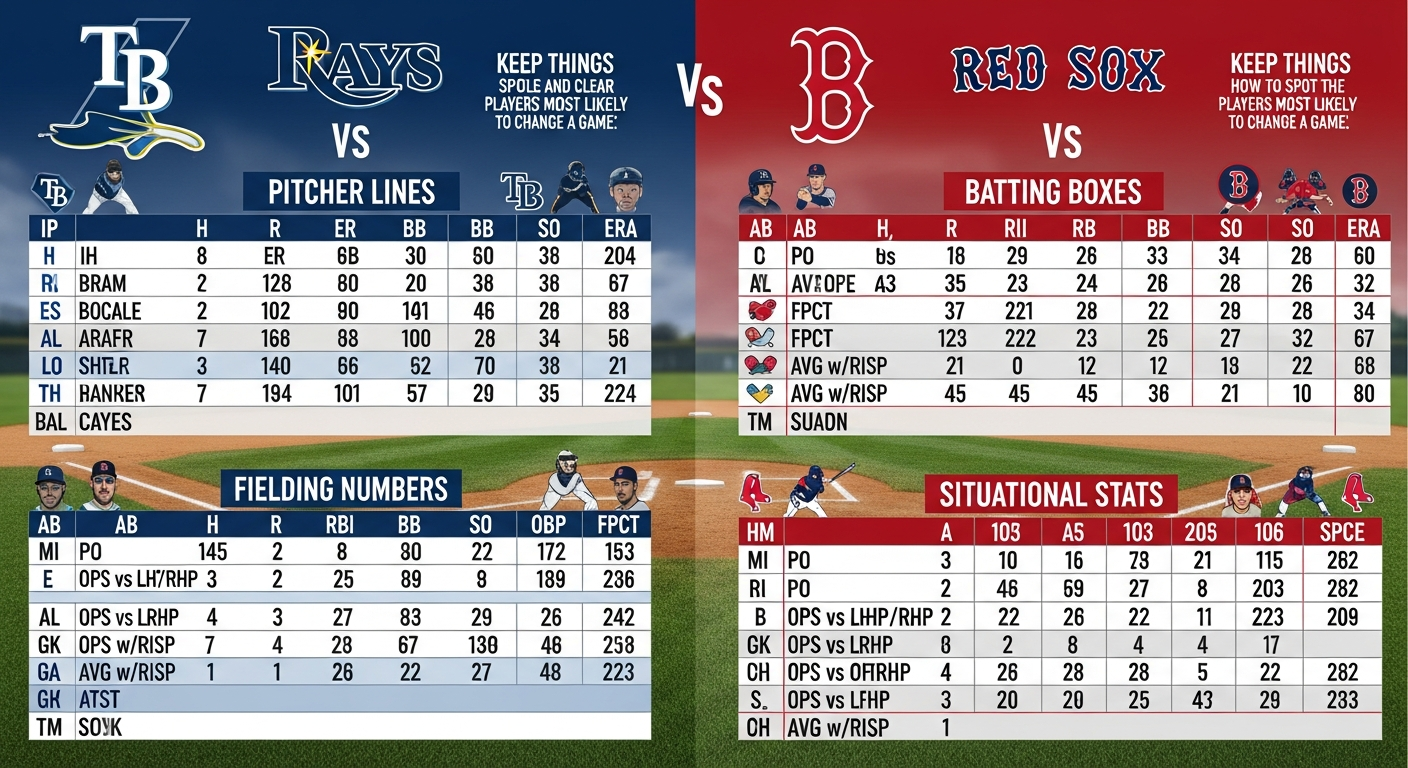
If you are looking for tampa bay rays vs red sox match player stats, you’re in the right place. This guide explains which stats matter, how to compare players from both teams, and how those numbers affect the result of a single game. We keep things simple and clear so anyone can follow along. You’ll learn how to read pitcher lines, batting boxes, fielding numbers, and situational stats. We also show sample tables and explain how to spot the players most likely to change a game. Whether you bet, play fantasy, or just enjoy baseball, understanding tampa bay rays vs red sox match player stats helps you watch smarter and enjoy the game more.
Why match player stats matter for a single game
Match player stats are the snapshot of performance for a single contest. When you check tampa bay rays vs red sox match player stats, you see who hit well, who pitched well, and who made game-changing plays. These numbers explain how the score happened.
A pitcher’s line shows innings, hits, runs, walks, and strikeouts. A batter’s box shows hits, walks, strikeouts, and extra-base hits. Fielding stats show errors and critical plays. For single-game analysis, look at these numbers together: a pitcher with many strikeouts but also many walks might have had control issues. That kind of view helps you understand the game beyond the final score.
How to read a pitcher’s line in the box score
When you read tampa bay rays vs red sox match player stats, the pitcher’s line is key. It usually looks like: IP (innings pitched), H (hits), R (runs), ER (earned runs), BB (walks), K (strikeouts), ERA (earned run average if season stat shown). For a single game, innings show how long a starter lasted. Hits and runs show how many batters got on base and scored.
Strikeouts and walks give clues about control and dominance. A low ER with many innings usually means a strong start. High strikeouts with few walks often indicate a pitcher dominating hitters. Always compare the starter’s line with the relievers’ lines to see who finished the game and how the bullpen performed.
How to read a hitter’s box score entry
A batter’s entry in tampa bay rays vs red sox match player stats shows AB (at-bats), R (runs), H (hits), 2B/3B/HR (extra-base hits), RBI (runs batted in), BB (walks), SO (strikeouts), and SB (stolen bases) sometimes. For example, a line like 4-2, 1 RBI shows four at-bats and two hits with one RBI. Extra-base hits are key: doubles and homers move runners and change scoring potential.
Walks show patience, and strikeouts show missed chances. For game-level analysis, look for who produced in key innings, which batters reached with two outs, and who drove in runs. That helps show clutch performers in that tampa bay rays vs red sox match player stats snapshot.

Interpreting advanced stats in a match context
Besides basic numbers, you may see advanced metrics in tampa bay rays vs red sox match player stats pages like exit velocity, xBA (expected batting average), or pitch type splits. For a single game, exit velocity shows how hard a ball was hit. Hard-hit balls with poor outcomes often indicate bad luck or great fielding.
Expected stats give a sense if a player over- or under-performed relative to contact quality. Pitch type splits show how batters fared against fastballs, sliders, etc., in that game. Use these advanced numbers to see if a player’s strong or weak performance was fluky or likely repeatable.
Matchup breakdown: pitchers vs batters
When you compare tampa bay rays vs red sox match player stats, the matchup is everything. Some hitters hit a specific pitcher well, and some pitchers have a pitch that keeps a lineup off balance. Look at how many times a hitter faced a pitcher and the outcomes.
Spot whether the pitcher threw more breaking balls or fastballs and how hitters adjusted. Also check handedness: lefty vs righty matchups often change lineups. A deeper look at the matchup helps explain why certain innings had high scoring, why managers made changes, and who had the tactical edge in the tampa bay rays vs red sox match player stats.
Defensive stats and game impact
Defense often decides close games, and tampa bay rays vs red sox match player stats include fielding numbers. Errors, aided outs, and highlight plays show defensive value. A single error can change the inning and the game result.
Defensive Runs Saved (DRS) or outs above average are common season metrics, but for match stats check plays that prevented runs. For example, a diving catch that ends an inning or a strong throw to home changes momentum. Fielders who make big plays in a tampa bay rays vs red sox match player stats box score deserve attention because they affect both run prevention and team morale.
Situational stats: runners in scoring position and late innings
For true game insight, look at situational tampa bay rays vs red sox match player stats: batting with RISP (runners in scoring position), two-out RBI, and late-inning performance. Teams often cluster their scoring in innings where multiple players reach base.
A batter who is 0-for-4 overall may have had the only inning with RISP and left key runners stranded. Late-inning clutch stats show who handled pressure well. Managers rely on these numbers to plan pinch hitters, lefty-righty switches, and bullpen matchups. Situational stats tell you whether a win was built by broad team effort or a few big moments.
Sample match player stats table (how to read it)
Below is a simple sample table for tampa bay rays vs red sox match player stats to show you how to read a game sheet. These are example entries to illustrate format—not real game numbers.
| Team | Player | AB | R | H | RBI | BB | SO | SB | Notes |
| Rays | Player A | 4 | 1 | 2 | 1 | 0 | 1 | 0 | 2B in 3rd |
| Red Sox | Player X | 5 | 2 | 3 | 2 | 0 | 0 | 1 | HR in 7th |
| Rays | Pitcher B | IP 6 | H 5 | R 2 | ER 2 | BB 1 | K 7 | — | Quality start |
| Red Sox | Pitcher Y | IP 5 | H 7 | R 4 | ER 3 | BB 3 | K 4 | — | Left with bases loaded |
This table is a model to help you parse the real tampa bay rays vs red sox match player stats you will find on box score pages. Read across rows to see each player’s full contribution.
How managers use match stats to make moves
Managers study tampa bay rays vs red sox match player stats closely to make decisions. If a starter has high pitch counts and many baserunners, the manager may call the bullpen early. If a hitter shows strong contact against a particular relief pitch, he may be protected or targeted.
Defensive alignment adjustments can follow stat trends in a game: shifting for pull hitters or protecting the line against bunts. Managers also read match stats to plan the next day: who needs rest, who needs extra batting practice, and who might be traded or promoted. The in-game numbers guide real-time strategy.
Fantasy and betting angles using match player stats
For fantasy players and bettors, tampa bay rays vs red sox match player stats are gold. Fantasy managers use box scores to set daily lineups based on who’s hot. Bettors compare pitching matchups, bullpen fatigue, and batting order health.
A pitcher who logged many innings the day before may underperform. A hitter with a high batting average in the park’s park factor could be a good daily start. Look for trends across recent games, not just one box score. The best fantasy and betting choices combine single-game stats with short-term trends to predict tomorrow’s performance.
Postgame stories: beyond the numbers
A box score shows what happened, but postgame interviews and reports explain why. After a tampa bay rays vs red sox match player stats review, read manager comments about pitch selection, a player’s injury, or an umpire’s call.
These narratives give context. Did a pitcher have a blister? Was a hitter dealing with an illness? Those details explain anomalies in the stats. Combine box score reading with postgame stories to form a full picture of the contest, and you will better understand why the stats look the way they do.
Common mistakes when reading match stats
Many fans misread single-game numbers. A large hit total for one player may be seen as proof of skill, but it could be luck. Conversely, a pitcher with many hits allowed but low earned runs could have been saved by defensive plays. Avoid overreacting to one game.
Instead, treat tampa bay rays vs red sox match player stats as pieces of a trend. Also, don’t ignore park effects Fenway or Tropicana Field can help or hurt power numbers. By avoiding these mistakes, you’ll make smarter evaluations from match stats.
Tools and sites to find reliable match stats
Many sites host tampa bay rays vs red sox match player stats in easy formats. Official MLB box scores are the source of truth. Other useful sites show pitch-level data, advanced metrics, and video replays. For simple reading, a box score and game recap work.
For deeper analysis, look for exit velocity, pitch maps, and zone charts on advanced platforms. Use reliable sources to avoid errors. Bookmark a few trusted pages and compare them when you study match stats to ensure accuracy.
How to build your own match stat tracker
If you want to track tampa bay rays vs red sox match player stats over a season, create a simple spreadsheet. Record player AB, H, HR, RBI, BB, SO, and pitcher IP, H, R, ER, BB, K for each game. Add a column for clutch plays and injuries. Over time, you’ll see trends and outliers.
Color-code hot streaks and slumps. This tracker is great for fantasy players and serious fans who want to spot form changes. It also helps you practice reading box scores and making predictions with real data.
Sample scouting note using match stats
Here’s a short scouting-style read from match stats: “In today’s tampa bay rays vs red sox match player stats, Rays’ starter pitched six innings with seven strikeouts but issued three walks.
That shows swing-and-miss stuff but control issues. Red Sox’ top of the order had multiple hits against breaking pitches, suggesting the Rays’ breaking ball lacked bite late. The bullpen gave up two late runs after walking batters, pointing to tired relievers. Defensively, a diving catch in the fifth saved two runs and changed momentum. Overall, the stats show a tight game decided by bullpen control.” This template helps translate numbers into narrative.
FAQs
The official MLB box score for the game is the most reliable source. It lists each batter’s and pitcher’s line, defensive plays, and play-by-play events. Team sites also host box scores and recaps. For advanced metrics, trusted analytics sites add exit velocity and pitch-level detail. Use the official box score first, then supplement with advanced tools.
Check quality of contact (exit velocity), pitch count, and situational hits. If a batter hits hard balls that drop for hits, the performance is more repeatable. If a pitcher struck out many batters with low pitch counts and few walks, it’s likely genuine. Combine single-game numbers with recent trends to judge sustainability.
No single stat predicts perfectly. Strikeout-to-walk ratio for pitchers and hard-hit rate for batters give good clues. But always combine multiple numbers and recent form. Look at platoon splits and park effects too when forecasting next game performance.
Yes. Errors show directly in box scores. Advanced sites flag plays saved and outs above average for season context. For individual games, read the play-by-play to see crucial defensive plays that don’t always appear as a stat but changed the inning.
Very important. RISP, two-out RBI, and late-inning performance show who delivered under pressure. Managers make many moves based on these numbers. For match-level analysis, situational stats often explain why a team won or lost.
Yes. For daily fantasy and betting, match stats inform lineup choices and prop bets. Combine single-game numbers with short-term trends and pitcher matchups. That gives the best view for making short-term decisions.
Conclusion: read, compare, and enjoy the game more
Studying tampa bay rays vs red sox match player stats makes baseball richer. Box scores and play-by-play show who did what. Advanced metrics explain how well things were done. Use the sample tables, matchup checks, and situational focus from this guide to read games better.
Track trends over several contests, not just one, and combine numbers with postgame reports for full context. Whether you are a fan, a fantasy player, or a bettor, learning to read match player stats turns every game into a story you can follow and predict.